
Various types of Oud
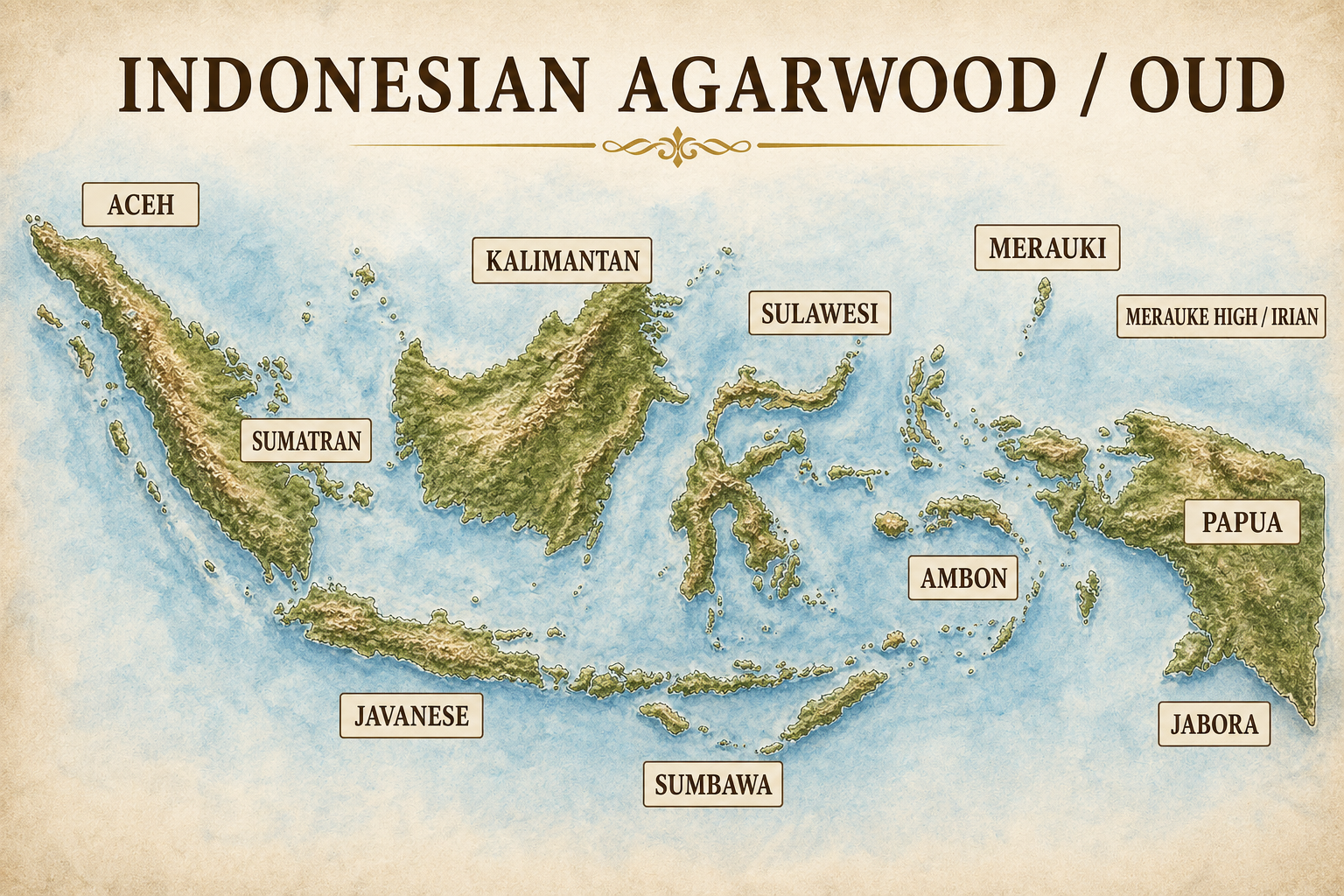
Executive Summary: Indonesia is one of the world's richest countries in agarwood (Oud or Garoo). Indonesian Agarwood (Oud) comes from various islands in Indonesia, such as Kalimantan, Sumatra, Papua, Java, and others, with several species of agarwood trees found, including Aquilaria Malaccensis, Aquilaria Beccariana, Aquilaria Filaria, and Aquilaria Microcarpa, as well as Gyrinops Species such as Gyrinops Versteegii and Gyrinops Caudata.
There are significant differences among eastern, southeastern, and western Indonesia in the species that produce aromatic resin and in scent intensity. Agarwood forms naturally within the wood of trees when they are infected with a fungus. The tree secretes resin to protect itself, and the heartwood becomes a dark, resin-rich substance.
The following is a detailed overview of each Indonesian agarwood species mentioned, including their botanical and geographical origins, resin composition, aroma profiles, physical properties, and associated names.
Natural Merauki / Moroci Oud:
A common type of Indonesian oud, primarily originating from Papua (especially the Maroke region of South West Papua).
The main plant species are Aquilaria and a group of Gyrinops, including Aquilaria filaria, which is widespread in Papua and New Guinea, and Gyrinops Versteegii.
It is typically extracted from old trees naturally infected with fungi in the eastern rainforests. Maroke is characterised by its brown colour (dark or light) and high resin content. The aroma is relatively mild, well-balanced, and consistent throughout the wood. It is often described as having earthy, green notes and a unique, "medicinal" aroma, reminiscent of dewy forest earth.
Maroke is used in formal and adult settings and is a favourite in the Gulf region due to its high quality and aroma, fetching hundreds of dollars per ounce (28 grams) in excellent condition. It is also known by similar names such as Maroke or Maroke Irian (referring to the former Irian region).
Natural Merauke High / Irian Oud:
This term refers to agarwood extracted from wild trees that have not been irrigated or cultivated, particularly in the forests of Papua (Irian).
The difference here is that it is "live," meaning natural, and has not undergone any artificial stimulation. The plant species are similar to those of common agarwood (Aquilaria Filaria and Gyrinops Versterii). It matures naturally after fungi infect the tree.
Merauke High / Irian Agarwood is said to have the same pure Agarwood aroma mixed with a strong forest character. It may be richer in resin due to the lack of human manipulation.
Its aroma is as long-lasting and of the same quality as regular agarwood, but it may be considered rarer due to the difficulty of harvesting it from rugged areas. (Source: A reasonable assumption based on the characteristics of natural agarwood.)
Natural Kalimantan Agarwood
This agarwood is produced from Aquilaria trees on the island of Borneo (part of Indonesia), locally known as "Kalimantan."
The main plant species are Aquilaria beccariana and Aquilaria microcarpa, endemic to the forests of Kalimantan, with a limited presence of Aquilaria malaccensis and some gorse.
The agarwood is harvested from wild trees in the lands of East Kalimantan and West Borneo. The bark is very resin-rich, and the wood is typically dark brown.
Its aroma is strong and distinctive, easily recognisable to connoisseurs. Unlike the milder Maroke, Kalimantan tends to have a sharp, warm, and powerful woody scent, with long-lasting earthy and woody notes.
Kalimantan is used in luxury incense burners and oriental perfumes and is highly prized in the Gulf markets. It is sometimes referred to as "Borneo Agarwood" or "Sarawak Agarwood" (a neighbouring Malaysian state), but the term "Kalimantan" is the internationally recognised name.
Natural Sumatran Agarwood
This refers to agarwood originating from the island of Sumatra (and the northern province of Aceh).
The main plant species is Aquilaria malaccensis, which grows in the Sumatran forests, as well as Aquilaria beccariana in some areas (recorded in Kalimantan).
Its wood has a light brown colour and a warm, balanced aroma with subtle sweetness and aromatic woods.
Sumatran agarwood is generally described as comfortable and relatively light compared to other types, and is widely used in everyday incense and perfumes.
Its longevity is generally moderate, and its resin content is good. It is produced in various grades (from standard to super), and is sometimes called "Sumatra agarwood" or "Sumatra agarwood." Currently, there are agricultural efforts to cultivate Aquilaria malaccensis in Sumatra because its quality is relatively stable.
Natural Papua Agarwood:
This agarwood, found in the Indonesian archipelago of Papua and southern New Guinea, generally represents the easternmost source of the Maroca family.
The prominent species here vary by region: Aquilaria filaria (native to New Guinea), Gyrinops caudata, and Gyrinops versteegii. Many Papua agarwood pieces come from ancient, wild trees in the jungles of Papua and are often dark brown and very aromatic.
The scent is reminiscent of a humid, dense tropical forest, with hints of wet earth and green grass (a description consistent with Maroca agarwood).
Due to its rarity, the finest quality agarwood is considered one of the best in the world and is often used for special occasions and religious ceremonies.
Natural Jabora Agarwood:
This type comes from a region called Jabora in Indonesia (possibly referring to Jabora in Papua or the Moluccas).
Some traders describe it as one of the rarest types of Indonesian oud. According to trade sources, Jabora is characterised by a light brown colour similar to that of Baitian oud and a light, fresh, and pleasant aroma.
It is said to have a delicate, pleasant fragrance that is not overpowering and does not cause allergies, with a long-lasting scent. It is considered one of the finest ouds from Indonesia and is used in high-quality incense and bonsai, and is highly valued in the Gulf region.
Its texture is generally light but rich in beautiful resin, giving it a fragrant and long-lasting aroma. It is sometimes called "old Jabora" or "Jara Bud."
Natural Aceh Agarwood:
A type of Sumatran agarwood specific to North Aceh province. Botanically, it is also part of the Aquilaria Malaccensis genus.
The relatively cool climate of Aceh gives the agarwood a light, pure, and fragrant aroma. Its scent is very similar to Sumatran agarwood, but some experts say that Aceh agarwood is thinner and slightly lighter in fragrance, making it ideal for everyday use and regular incense burning.
Aceh agarwood is often sold under the name "North Sumatran agarwood" in Indonesian and Arab markets.
Natural Javanese Agarwood:
This refers to oud from the Indonesian island of Java. The base plant is Aquilaria malaccensis, and sometimes Aquilaria beccariana in East Java.
This oud is typically lighter in aroma than Kalimantan and Sumatra Oud, and has a moderate longevity.
It is said to impart a mild, bright, woody scent, suitable for everyday use and moderate occasions, rather than formal events.
It is considered less valuable than other varieties but is still used in local incense and perfume making. It is sometimes known as “Javaean Oud” or “traditional Indonesian Oud.”
Natural Kahidop Agarwood:
Clear scientific information about this species is lacking in the sources, and it appears to be a rare trade or local name.
It is sometimes referred to among the eastern varieties of agarwood in Indonesia. It may be associated with a specific region or a unique tree, but precise details (specific plant species or island) are unknown.
Based on the list of affiliates, it may refer to a source from the remote islands of eastern Indonesia, but this is obscure.
As of now, it can be said with limited confidence that Kahidop Oud is an incompletely scientifically defined species, often classified as a high-quality variety within the eastern Indonesian range.
Natural Sumbawa Agarwood:
A rare species from Lombok/Sumbawa Island in the Lesser Sunda Islands.
It's likely tree species could be Gyrinops versteegii (like the rest of the Lesser Sunda region) or Aquilaria filaria.
Sumbawa is said to have a balance of sweetness and smoky notes with long-lasting longevity, making it unique compared to other Javanese Oud.
Traders demand it in very high grades, and it is expensive due to its rarity. (Well-documented studies on it were not available until 2026, so its characteristics remain general estimates.)
Natural Ambon Agarwood:
It comes from the Moluccas Islands, particularly from Ambon and Namlia.
Its botanical sources include Gyrinops moluccana, Gyrinops versteegii, and sometimes Aquilaria cumingiana. The wood is often dark brown with prominent resin veins.
Its aroma is deep and sharp compared to Western varieties: similar to warm woods with woody notes that develop into light, aromatic herbs.
It is highly prized in eastern Indonesia, especially rare antique pieces (dating back to the 1950s or earlier), sought after by professional collectors. It is also known as "Garo Maluku," particularly the blue variety (if it has a blue color due to the concentration of resin).
Natural Sulawesi Agarwood:
This name most likely refers to Sulawesi oud from the Indonesian island of Sulawesi. Sulawesi is also abundant with Aquilaria trees.
According to oud retailers, Sulawesi is considered a premium variety; large pieces are often classified as super (double super and triple super).
Its scent is described by some experts as exquisitely beautiful and sweet, with exceptional longevity and diffusion. Sulawesi is said to share some characteristics with Laotian and Vietnamese oud and may have a light, balanced, and playful aromatic quality.
Experts consider it one of the finest Indonesian oud varieties due to its unique characteristics and long-lasting fragrance.
Enhanced/Synthetic Indonesian Agarwood:
This is not a natural type in itself, but rather refers to agarwood that has been treated or enhanced. This category includes pieces that have been processed or liquefied to artificially enhance their aroma and fragrance.
For example, Aquilaria wood is often injected or peeled to stimulate resin formation (using fungal infusions or chemicals), or the wood is soaked in concentrated oils after cutting. This type of agarwood is sometimes called “synthetic” or “enhanced.”
Generally, its aroma tends to be less complex and less diffused than natural wild agarwood, and it may exhibit chemical notes or added fragrances.
Enhanced agarwood is used economically in simple home incense and inexpensive perfumes, and is considered inferior to natural agarwood.
Scientific sources indicate that injecting trees produces what is called “resin scratching” or “fake agarwood,” which is less flavorful and of lower quality.
Identifying this type requires expertise: specialists can distinguish between the small, jagged pieces of enhanced agarwood and the larger, pure pieces of natural agarwood.