
The world oud guide
13 countries • 86 regional and local labels. Understand origins and market names before choosing your oud.
Oud is fragrant resin-bearing wood formed in certain Aquilaria and Gyrinops trees in response to stress or injury. Chips are used for incense and oud oil is obtained by distillation. Country and region names are not separate botanical species or fixed quality grades.
Maps are approximate locators with decorative terrain, not harvesting maps. Tap a map to enlarge it. Name links open the matching category where available; otherwise they open the country collection or all natural oud. A link does not guarantee availability of that exact type.
Understanding aroma and choosing your oud
• Aroma: agarwood samples can show woody, sweet, spicy and resinous notes. These sensory descriptions vary with the tree, resin, processing and heat; they are not country-wide guarantees.
• Appearance: chips, grain and resin patterns vary. Darkness or sinking alone cannot authenticate origin or quality. The photographs below show particular products, not every oud from that region.
• Occasions: choose a comfortable scent and a small amount for daily use. For guests, Eid or weddings, test projection in the room beforehand. These are taste-based suggestions, not scientific country traits.
• Use: gently heat a small chip in a suitable burner with ventilation; never leave hot charcoal unattended. Apply oil to skin only if labelled for that use and follow its directions. Store away from heat and sunlight.
India oud
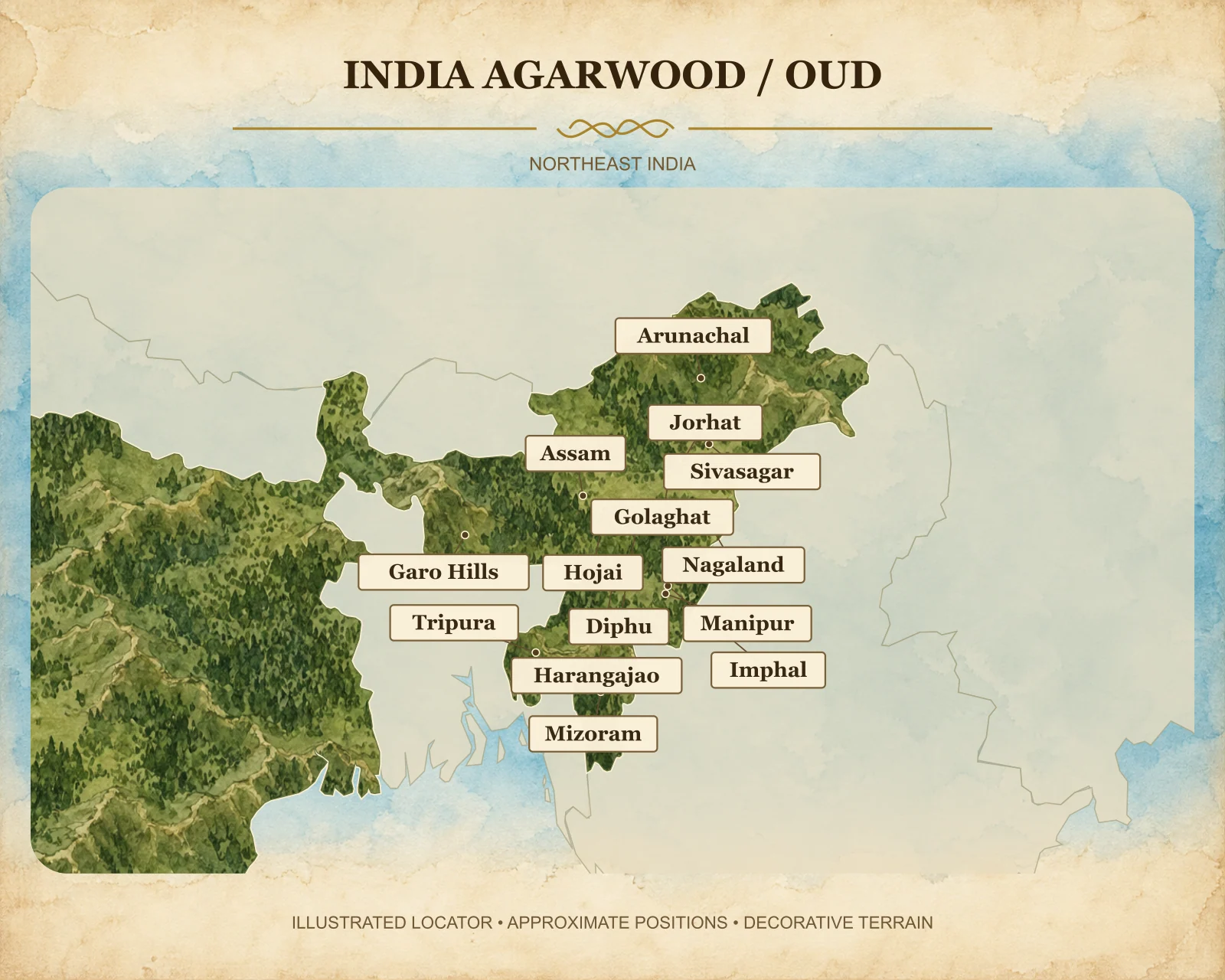
Hindi oud is a broad commercial name for Indian agarwood, with a strong association with the northeast. Aquilaria malaccensis is an important source, and Assam has an established cultivation and processing sector.
• Aroma: our Assam 561 listing describes warm woody notes; Indian Earthy Oil 158 describes an earthy character. These are individual products, not a profile for every Indian oud.
• Identification: inspect grain, resin pattern and chip integrity, then request batch origin. Dark colour alone does not prove authenticity.
• Suggested use: chips for home incense, welcoming guests and Eid; oil for personal fragrance according to its label. Choose intensity by sampling.
1. Assam Oud
• Assam.
• Broad state-level label.
• Compare chips and oil.
2. Golaghat Oud
• Golaghat District, Assam.
• A district label within Assam, not a separate botanical species.
• Compare chips and oil.
3. Hojai Oud
• Hojai District, Assam.
• A recognised processing and trading reference.
• Compare chips and oil.
4. Jorhat Oud
• Jorhat District, Assam.
• A district/city reference in Assam.
• Compare chips and oil.
• Sivasagar District, Assam.
• Another Assam district label.
• Compare chips and oil.
6. Diphu Oud
• Diphu, Karbi Anglong District, Assam.
• A locality within Karbi Anglong.
• Compare chips and oil.
• Harangajao, Dima Hasao District, Assam.
• A locality in the Dima Hasao area.
• Compare chips and oil.
8. Nagaland Oud
• Nagaland.
• A neighbouring northeastern state label, distinct from Assam.
• Compare chips and oil.
9. Manipur Oud
• Manipur.
• A state label.
• Compare chips and oil.
• Imphal, Manipur.
• A city name nested within Manipur, not an additional tree species.
• Compare chips and oil.
11. Mizoram Oud
• Mizoram.
• A northeastern state name.
• Compare chips and oil.
12. Tripura Oud
• Tripura.
• A northeastern state name used to identify a broad supply area.
• Compare chips and oil.
13. Garo Hills Oud
• Garo Hills, Meghalaya.
• A hill-region label within Meghalaya.
• Compare chips and oil.
14. Arunachal Oud
• Arunachal Pradesh.
• A broad northeastern state label.
• Compare chips and oil.
Thailand oud
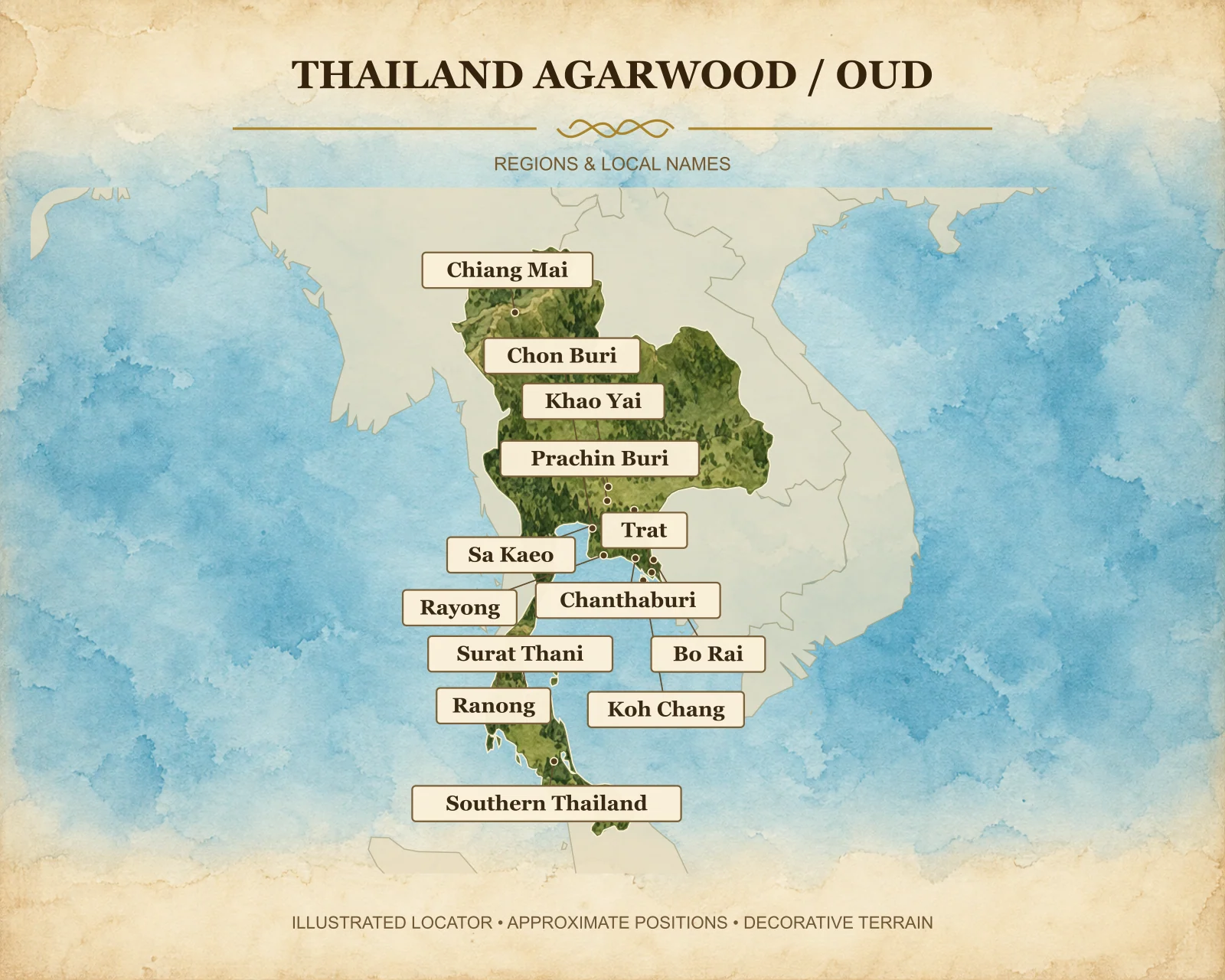
Thai oud includes material from several regions and from cultivated trees. Aquilaria crassna is an important agarwood-producing species in mainland Southeast Asia.
• Aroma: Trat, Chanthaburi and other regional labels have no single scent. Compare woodiness, sweetness and sharpness in a gently heated sample.
• Identification: ask about the tree, induction and added fragrance. A province name does not establish wild origin or absence of treatment.
• Suggested use: a gentle batch for everyday incense, or a scent you enjoy for guests and celebrations. Select by the sample, not the country.
15. Trat / Trad Oud
• Trat Province.
• Eastern Thai province on the Cambodian frontier.
• Check cultivation method.
16. Chanthaburi / Jantaburi Oud
• Chanthaburi Province.
• An eastern province distinct from Trat, even when both appear in the same commercial supply chain.
• Check cultivation method.
17. Prachin Oud
• Prachin Buri Province.
• A province reference often shortened to Prachin.
• Check cultivation method.
18. Khao Yai Oud
• Khao Yai mountain and forest region.
• A mountain and forest-region name rather than a single province.
• Check cultivation method.
19. Surat Oud
• Surat Thani Province.
• Short for Surat Thani in southern Thailand.
• Check cultivation method.
20. Chiang Mai Oud
• Chiang Mai Province.
• A northern Thai province, geographically separate from the eastern Trat group.
• Check cultivation method.
21. Sa Kaeo Oud
• Sa Kaeo Province.
• An eastern border-province label.
• Check cultivation method.
22. Ranong Oud
• Ranong Province.
• A southern province on the Andaman side of Thailand.
• Check cultivation method.
• Bo Rai District, Trat Province.
• A district within Trat.
• Check cultivation method.
24. Koh Chang Oud
• Koh Chang Island, Trat Province.
• An island within Trat.
• Check cultivation method.
25. Rayong Agarwood
• Rayong Province.
• An eastern coastal province.
• Check cultivation method.
• Chon Buri Province.
• Another eastern coastal province, distinct from nearby Rayong.
• Check cultivation method.
• Southern Thailand.
• An umbrella label covering several provinces rather than one specific growing site.
• Check cultivation method.
Malaysia oud
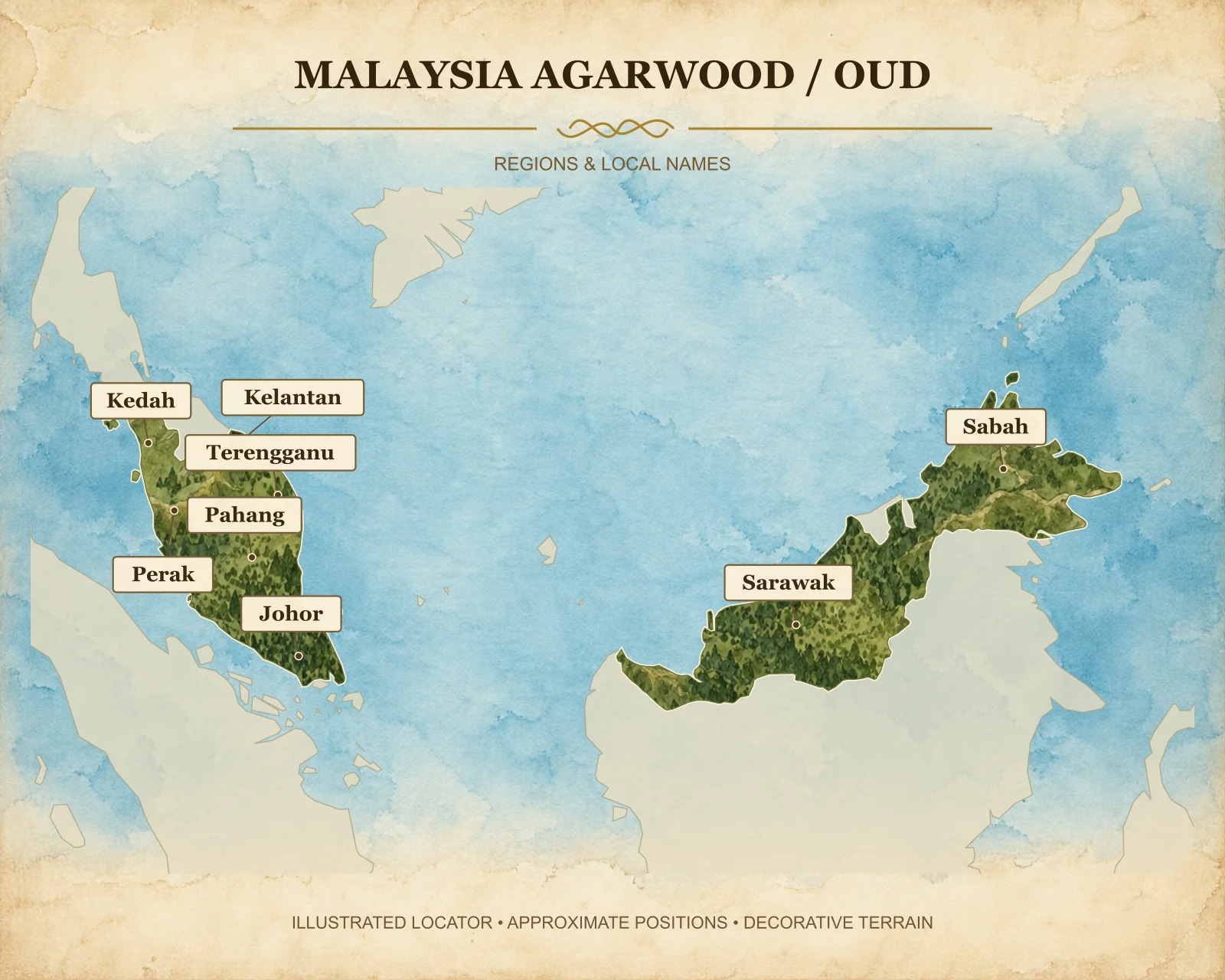
Malaysian oud spans Peninsular Malaysia and the Malaysian part of Borneo. These are geographically distinct supply areas.
• Aroma: evaluate the balance of woodiness, resin and sweetness in the lot; a state name alone cannot establish those notes.
• Identification: distinguish Peninsular Malaysia from Malaysian Borneo. Check supplier records as well as the grain rather than relying on colour.
• Suggested use: incense for a majlis or family visits; for gifting, choose a tested batch with clear origin and treatment information.
28. Johor Oud
• Johor.
• Southern Peninsular Malaysia.
• Check added fragrance.
29. Kedah Oud
• Kedah.
• A northwestern peninsular state.
• Check added fragrance.
30. Pahang Oud
• Pahang.
• A large peninsular state.
• Check added fragrance.
31. Terengganu Oud
• Terengganu.
• An east-coast peninsular state, distinct from neighbouring Kelantan.
• Check added fragrance.
• Kelantan.
• A northeastern peninsular state.
• Check added fragrance.
33. Perak Oud
• Perak.
• A western peninsular state.
• Check added fragrance.
34. Sabah Oud
• Sabah, Malaysian Borneo.
• A Malaysian state in northern Borneo.
• Check added fragrance.
35. Sarawak Oud
• Sarawak, Malaysian Borneo.
• A Malaysian state on Borneo.
• Check added fragrance.
Ipoh (Perak), Kota Bharu (Kelantan) and Bukit Mertajam (Penang) are places; separate harvesting origins for these labels are unverified.
Indonesia oud
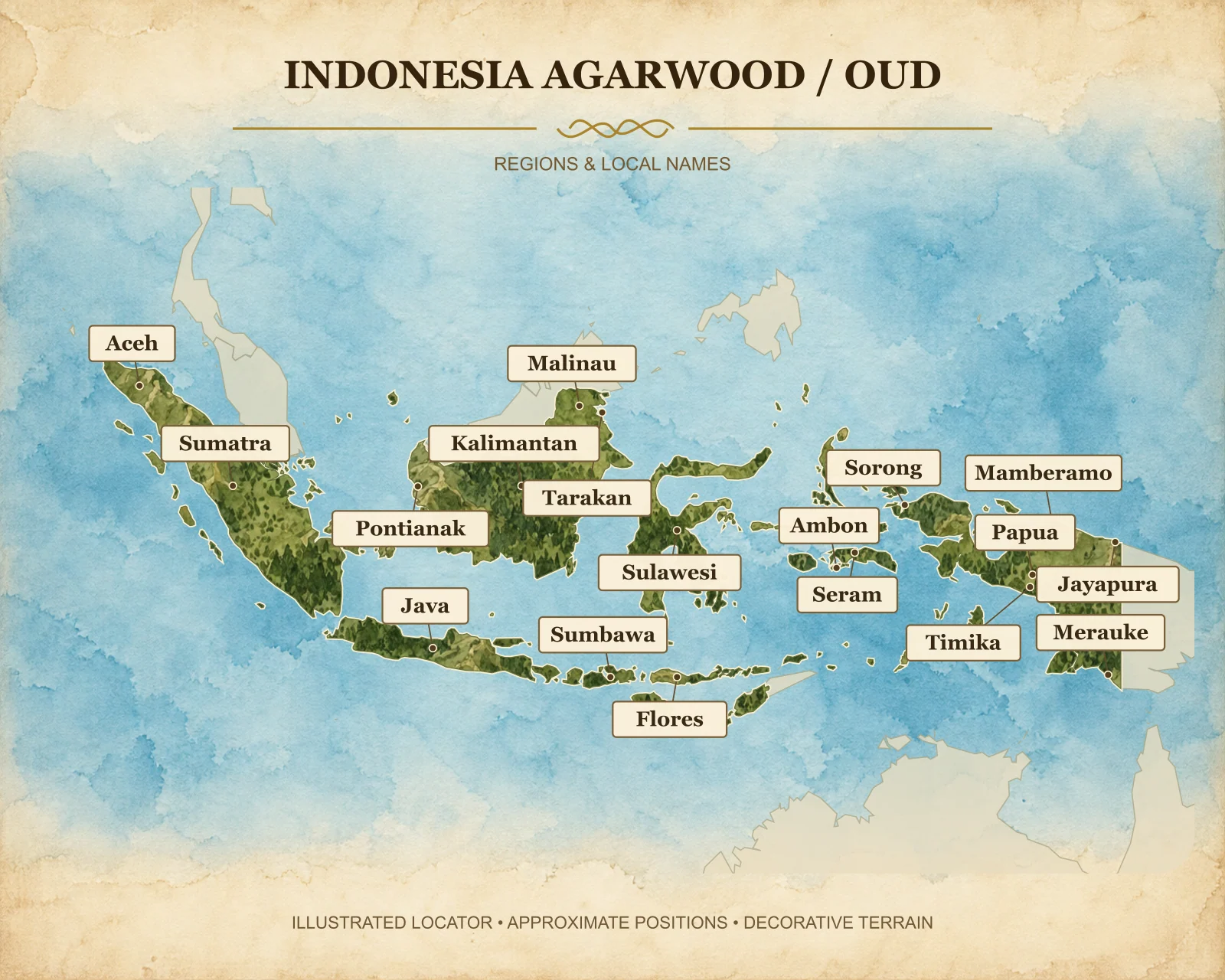
Indonesia is a large archipelago with several agarwood-producing Aquilaria and Gyrinops species. Its island names cover diverse environments and supply chains, so Indonesian oud cannot be reduced to a single scent profile.
• Aroma: Kalimantan, Merauke and Sumatra cover many lots, not fixed scents. Sample the chip and follow how its aroma develops before raising the heat.
• Identification: chip shapes and grain depend on the tree and cutting. A photograph helps comparison but cannot prove island origin or grade.
• Suggested use: a small amount at home, or a batch you enjoy for Eid hospitality or wedding gatherings. Projection belongs to the product, not its name.
36. Sumatran Oud
• Sumatra.
• Broad island label.
• Compare a heated sample.
37. Aceh Oud
• Aceh, northern Sumatra.
• Northern Sumatra.
• Compare a heated sample.
38. Javanese Oud
• Java.
• Java is a separate island from Sumatra and Borneo.
• Compare a heated sample.
39. Kalimantan Oud
• Indonesian part of Borneo.
• The Indonesian part of Borneo.
• Compare a heated sample.
• Malinau Regency, North Kalimantan.
• A North Kalimantan locality.
• Compare a heated sample.
41. Tarakan Oud
• Tarakan, North Kalimantan.
• An island/city reference in North Kalimantan.
• Compare a heated sample.
42. Pontianak Oud
• Pontianak, West Kalimantan — regional trade label.
• A West Kalimantan trading-city label.
• Compare a heated sample.
43. Sulawesi Oud
• Sulawesi.
• A separate island east of Borneo.
• Compare a heated sample.
44. Sumbawa Oud
• Sumbawa Island, West Nusa Tenggara.
• A Lesser Sunda island, distinct from Lombok and Java.
• Compare a heated sample.
45. Flores Agarwood
• Flores Island, East Nusa Tenggara.
• An island in East Nusa Tenggara with published Gyrinops research.
• Compare a heated sample.
46. Ambon Oud
• Ambon, Maluku.
• A Maluku locality.
• Compare a heated sample.
47. Seram Agarwood
• Seram Island, Maluku.
• A separate Maluku island.
• Compare a heated sample.
48. Papuan Oud
• Indonesian Papua.
• A broad Indonesian geographic label.
• Compare a heated sample.
• Jayapura area, Papua.
• Jayapura is in northern Papua.
• Compare a heated sample.
• Merauke area, South Papua.
• Merauke is in southern New Guinea, within Indonesia.
• Compare a heated sample.
51. Mamberamo Oud
• Mamberamo region, Indonesian Papua.
• A northern Papuan region associated with the Mamberamo river basin.
• Compare a heated sample.
52. Timika Oud
• Timika, Mimika Regency, Central Papua.
• A locality in the Mimika area.
• Compare a heated sample.
53. Sorong Oud
• Sorong area, Southwest Papua.
• A western New Guinea locality.
• Compare a heated sample.
Merauke High / Moroci Hai / Irian: Irian is a historical regional name. The trade meaning of High/Hai requires supplier clarification; it does not prove wild origin, lack of induction or higher quality.
Cambodia oud
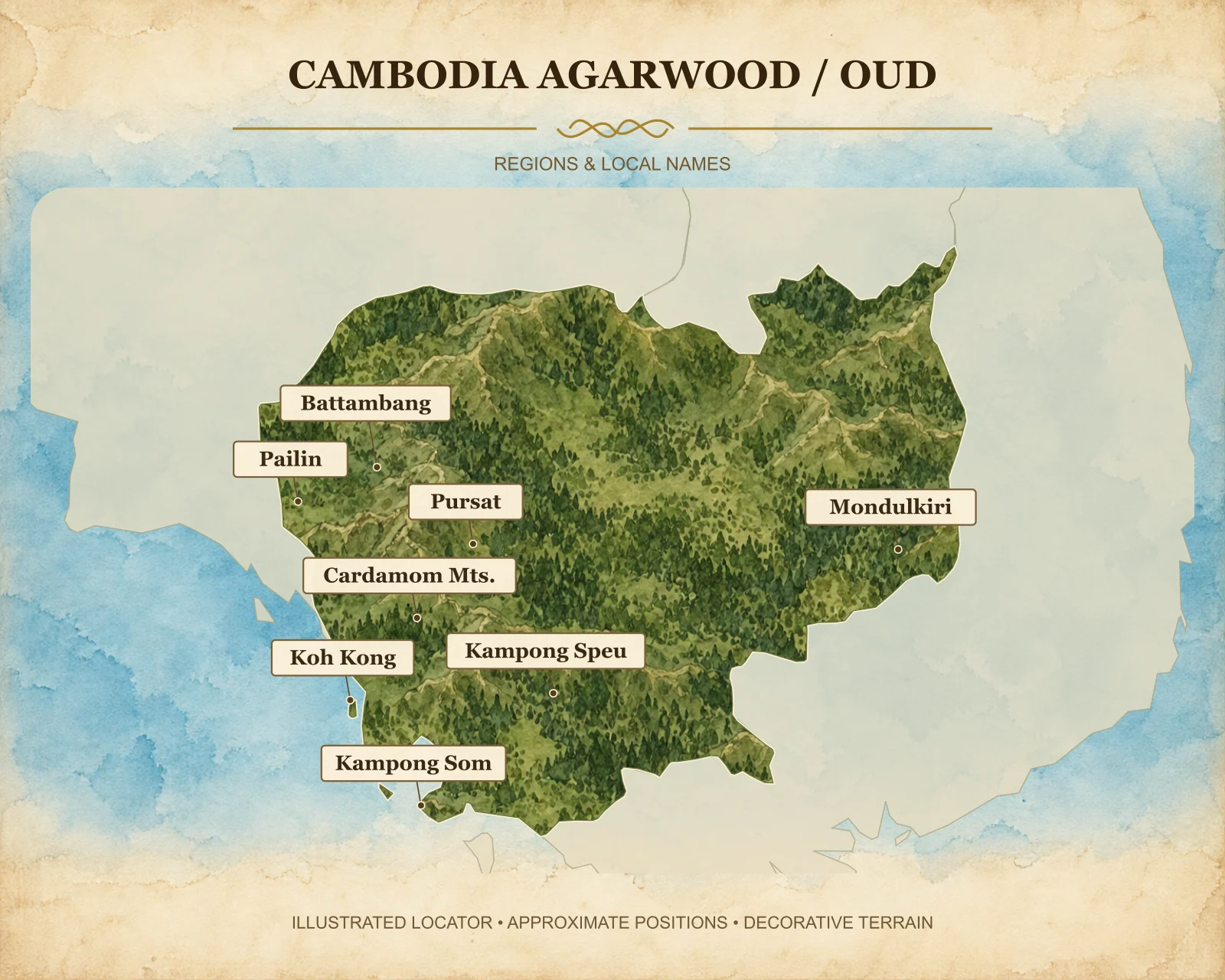
Cambodi oud is a country-of-origin or trade description, not a botanical species. Aquilaria crassna is associated with the region.
• Aroma: a study described sweetness in some Cambodian samples. This does not make every Cambodian lot sweet or identical; resin formation and processing matter.
• Identification: Pursat and Koh Kong are origin labels. Check provenance rather than treating chip size or darkness as a complete quality test.
• Suggested use: if you enjoy a sweet sample, consider it for welcoming guests or gifting; a smaller amount can suit everyday incense.
54. Pursat Oud
• Pursat Province.
• A western Cambodian province name.
• Assess the actual aroma.
55. Koh Kong Oud
• Koh Kong Province.
• A southwestern coastal province associated geographically with the Cardamom region.
• Assess the actual aroma.
56. Pailin Oud
• Pailin Province.
• A western border province, distinct from the broader Battambang label.
• Assess the actual aroma.
• Battambang Province.
• A western province.
• Assess the actual aroma.
• Kampong Speu Province.
• A province reference west of Phnom Penh.
• Assess the actual aroma.
59. Kampong Som Oud
• Sihanoukville / Kampong Som area.
• A traditional name associated with the Sihanoukville area.
• Assess the actual aroma.
• Mondulkiri Province.
• An eastern upland province, geographically separate from the southwestern Cardamom area.
• Assess the actual aroma.
• Cardamom Mountains, southwestern Cambodia.
• A mountain region that crosses provincial boundaries.
• Assess the actual aroma.
Laos oud
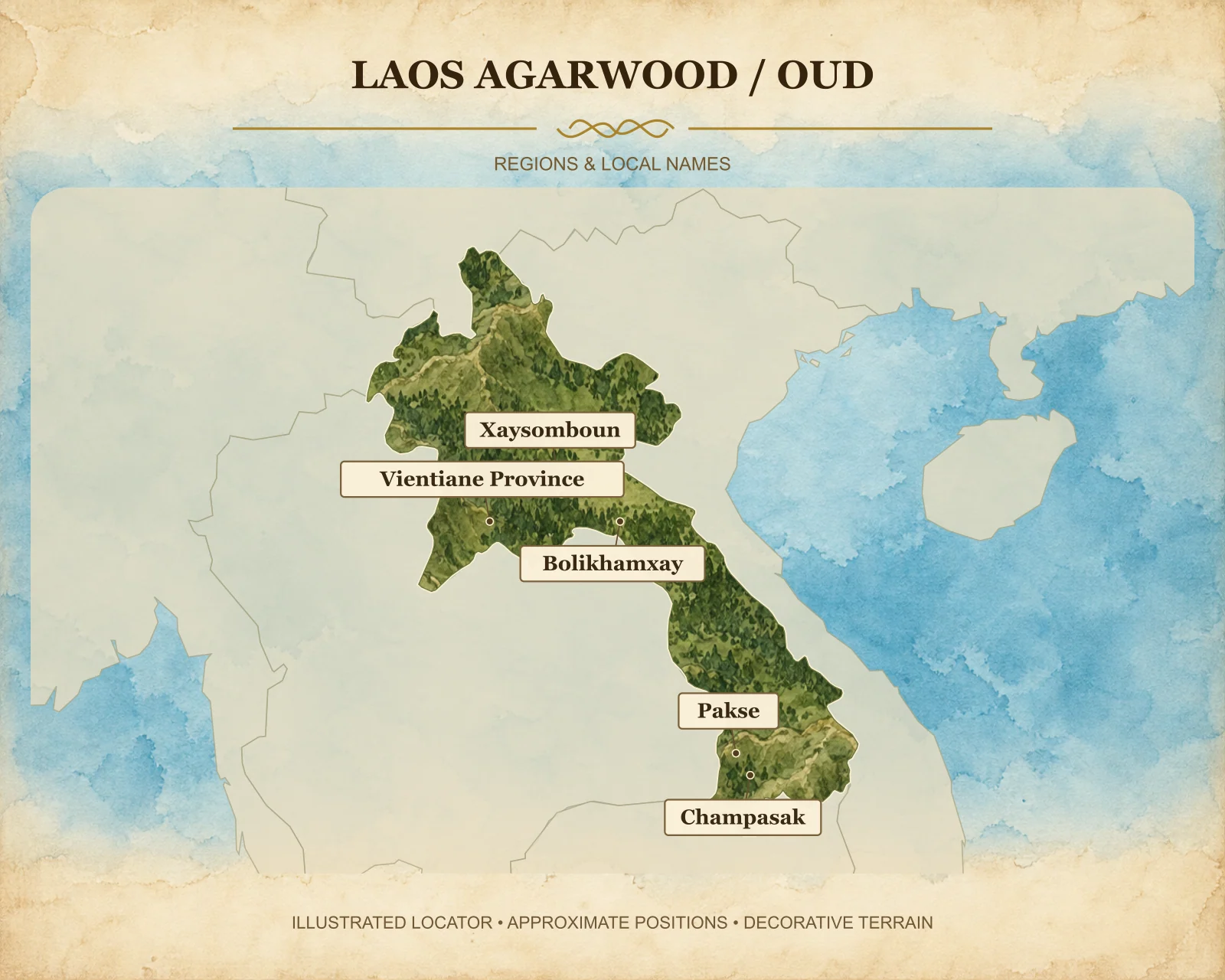
Laotian oud is associated with mainland Southeast Asian agarwood, including Aquilaria crassna. Forestry research documents this species in Laos.
• Aroma: verified sensory profiles for every province are unavailable here. Evaluate the heated wood and its oil separately; they need not smell identical.
• Identification: separate the distilling location from the tree source. Ask about the batch, resin formation and additives.
• Suggested use: chips for a majlis or occasion, and oil for personal fragrance when labelled for skin use. Let the sample determine intensity.
62. Pakse Oud
• Pakse, Champasak Province.
• A city in Champasak.
• Verify the named source.
• Champasak Province.
• A southern province.
• Verify the named source.
• Vientiane Province.
• Here the label refers to Vientiane Province, which should not be confused with the capital prefecture.
• Verify the named source.
• Bolikhamxay Province.
• A central Laotian province label.
• Verify the named source.
• Xaysomboun Province.
• An inland upland province label.
• Verify the named source.
Vietnam oud
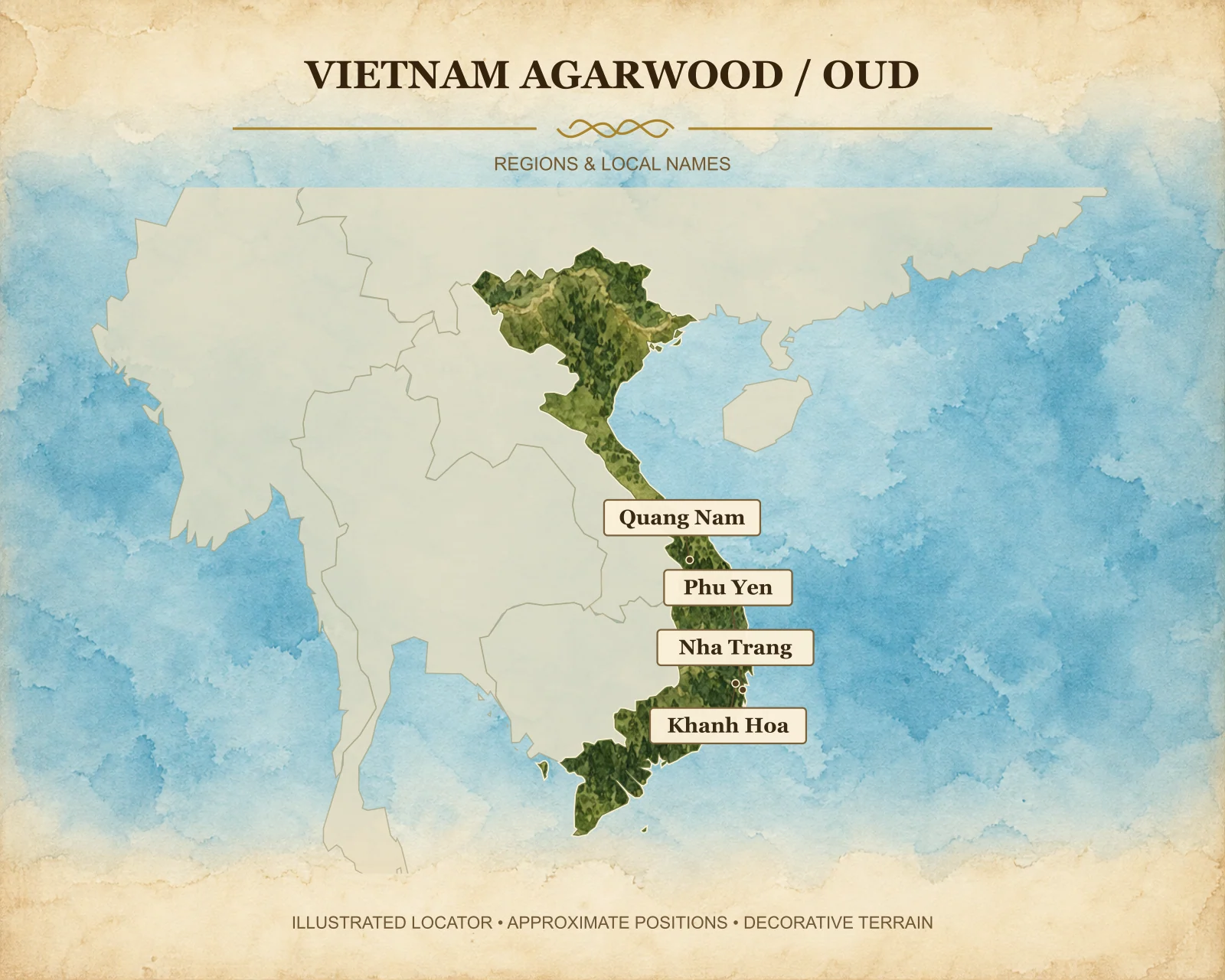
Vietnam has a long agarwood tradition and documented cultivation of Aquilaria crassna. Nha Trang and Khanh Hoa are closely connected geographic names, while other regional names remain common in trade even when administrative boundaries change.
• Aroma: research finds differences between samples. Nha Trang or Khanh Hoa does not establish a specific scent or prove that a lot is kinam.
• Identification: request species and treatment details. Kinam and kyara are specialised terms that a photo or regional label cannot authenticate.
• Suggested use: small incense sessions to appreciate detail, or a gift for an oud enthusiast after checking the lot; grades are not interchangeable.
67. Nha Trang Oud
• Nha Trang area, Khanh Hoa.
• A coastal city/area associated with Khanh Hoa, not an additional botanical type.
• Ask how oil was distilled.
• Khanh Hoa region.
• A broader regional label that includes the Nha Trang association.
• Ask how oil was distilled.
69. Quang Nam Oud
• Quang Nam region.
• A central Vietnamese regional name retained in trade.
• Ask how oil was distilled.
70. Phu Yen Oud
• Phu Yen region.
• A south-central regional name retained in trade.
• Ask how oil was distilled.
Bangladesh oud
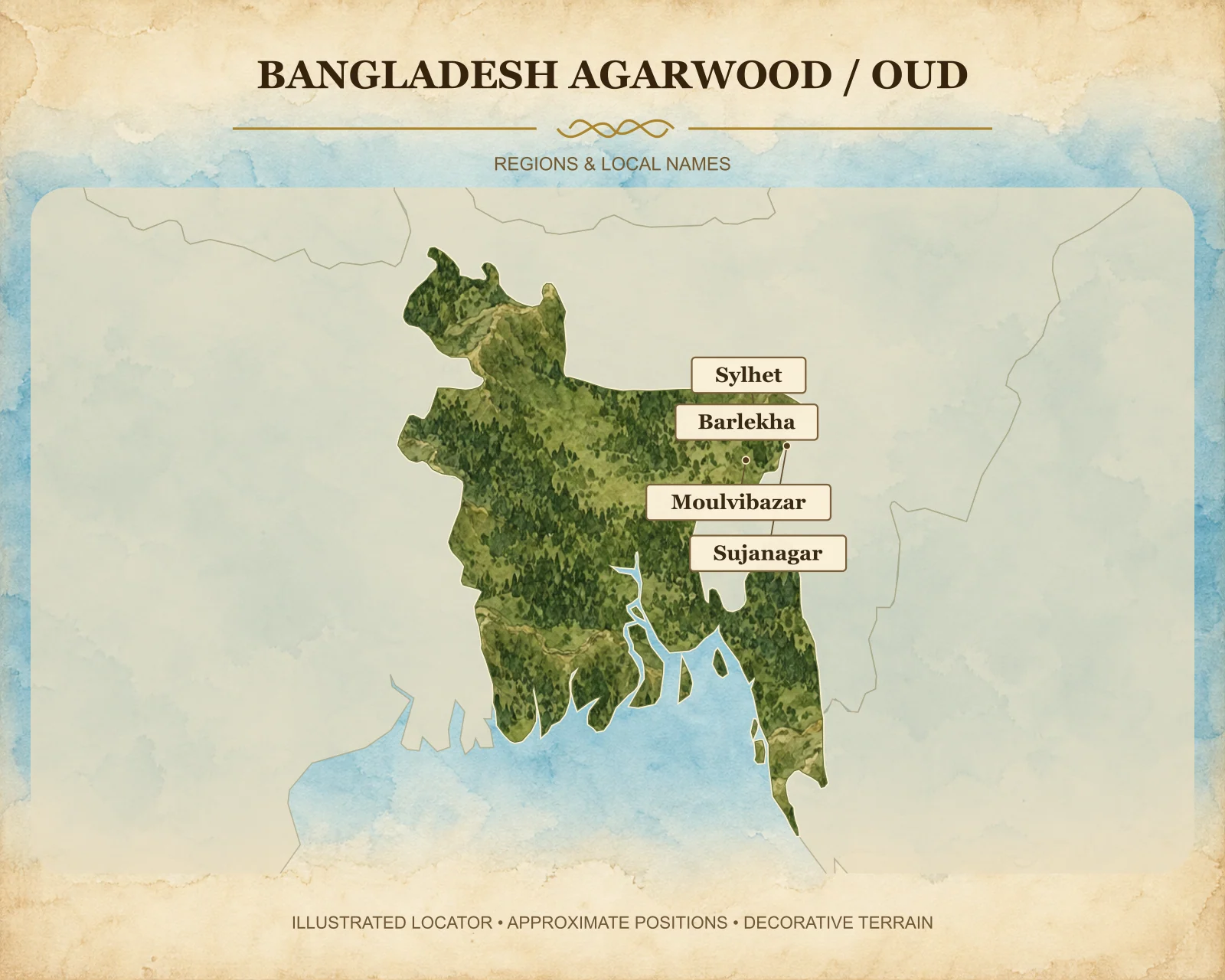
Bangladeshi agarwood is closely associated with the Sylhet area. Research documents Aquilaria malaccensis cultivation, processing and oil production in Barlekha, Moulvibazar.
• Aroma: raw wood, distillation and ageing influence the oil. Sylhet and Sujanagar products cannot all be assigned one scent.
• Identification: distinguish solid incense chips from liquid oud oil. Ask whether the oil is pure or blended and where it was distilled.
• Suggested use: oil for daily fragrance or an occasion according to strength and label; chips for home incense and hospitality, not skin application.
71. Sylheti Oud
• Sylhet Division.
• Broad regional name that includes more specific production areas.
• Confirm distillery origin.
• Moulvibazar District, Sylhet Division.
• A district within Sylhet.
• Confirm distillery origin.
• Barlekha Upazila, Moulvibazar District.
• A subdistrict with documented agarwood cultivation and processing.
• Confirm distillery origin.
74. Sujanagar Agarwood / Agar Attar
• Sujanagar Union, Barlekha Upazila — cultivation and production centre.
• A local production and distillation centre within Barlekha.
• Confirm distillery origin.
Myanmar oud
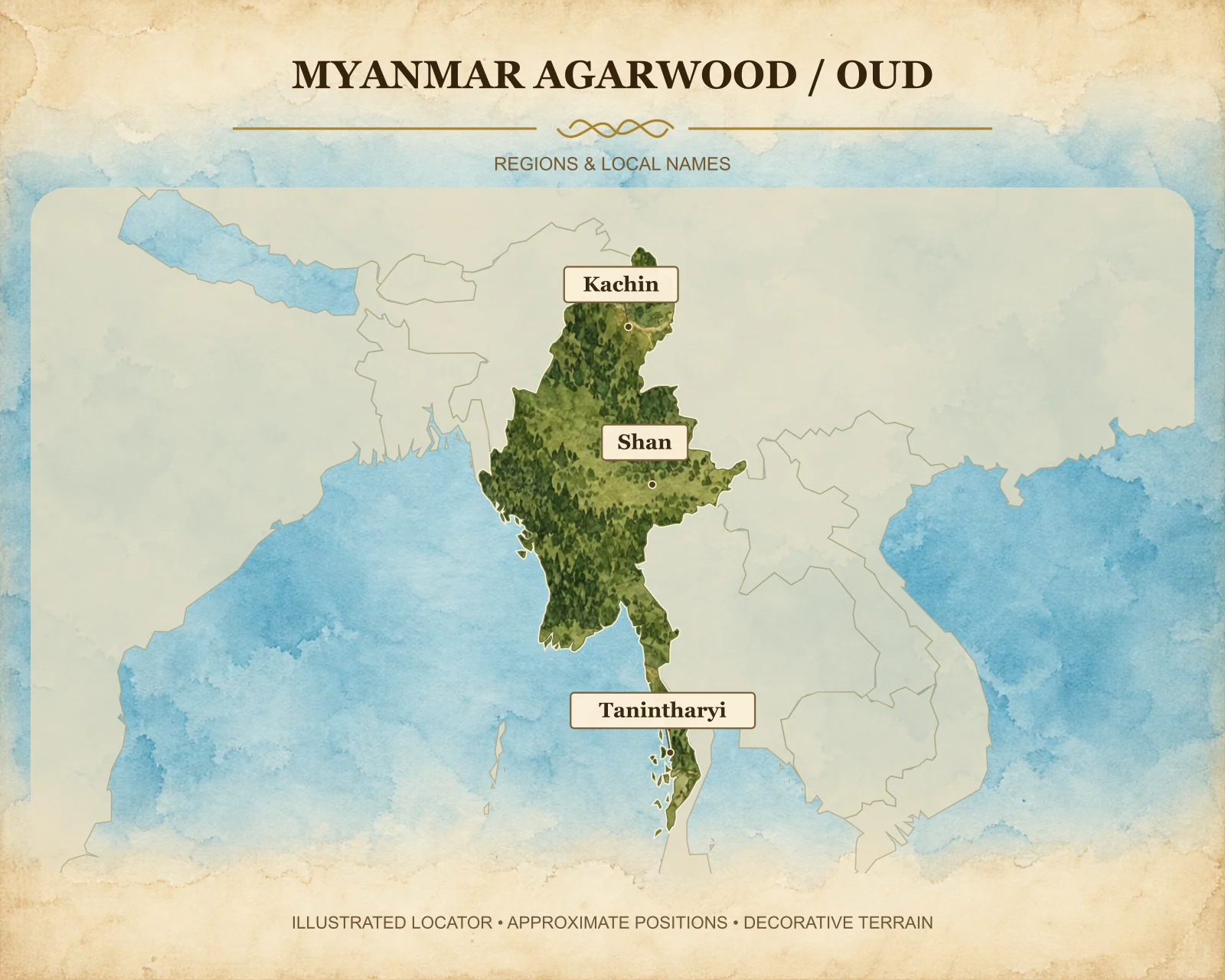
Burmese oud refers to agarwood associated with Myanmar. The country includes very different northern, eastern and southern environments.
• Aroma: a uniform sensory profile is not established for Kachin, Shan or Tanintharyi. Compare a sample of the actual batch.
• Identification: Myanmar is a broad origin. Supplier records are more useful for provenance than chip shape, alongside disclosure of additives.
• Suggested use: choose for home incense or celebrations after testing projection. An occasion recommendation is not a quality grade.
75. Kachin Oud
• Kachin State.
• A northern state label.
• Ask for sourcing records.
76. Shan Agarwood
• Shan State.
• An eastern upland state label.
• Ask for sourcing records.
77. Tanintharyi / Tenasserim Agarwood
• Tanintharyi Region.
• A southern coastal-region label.
• Ask for sourcing records.
China oud
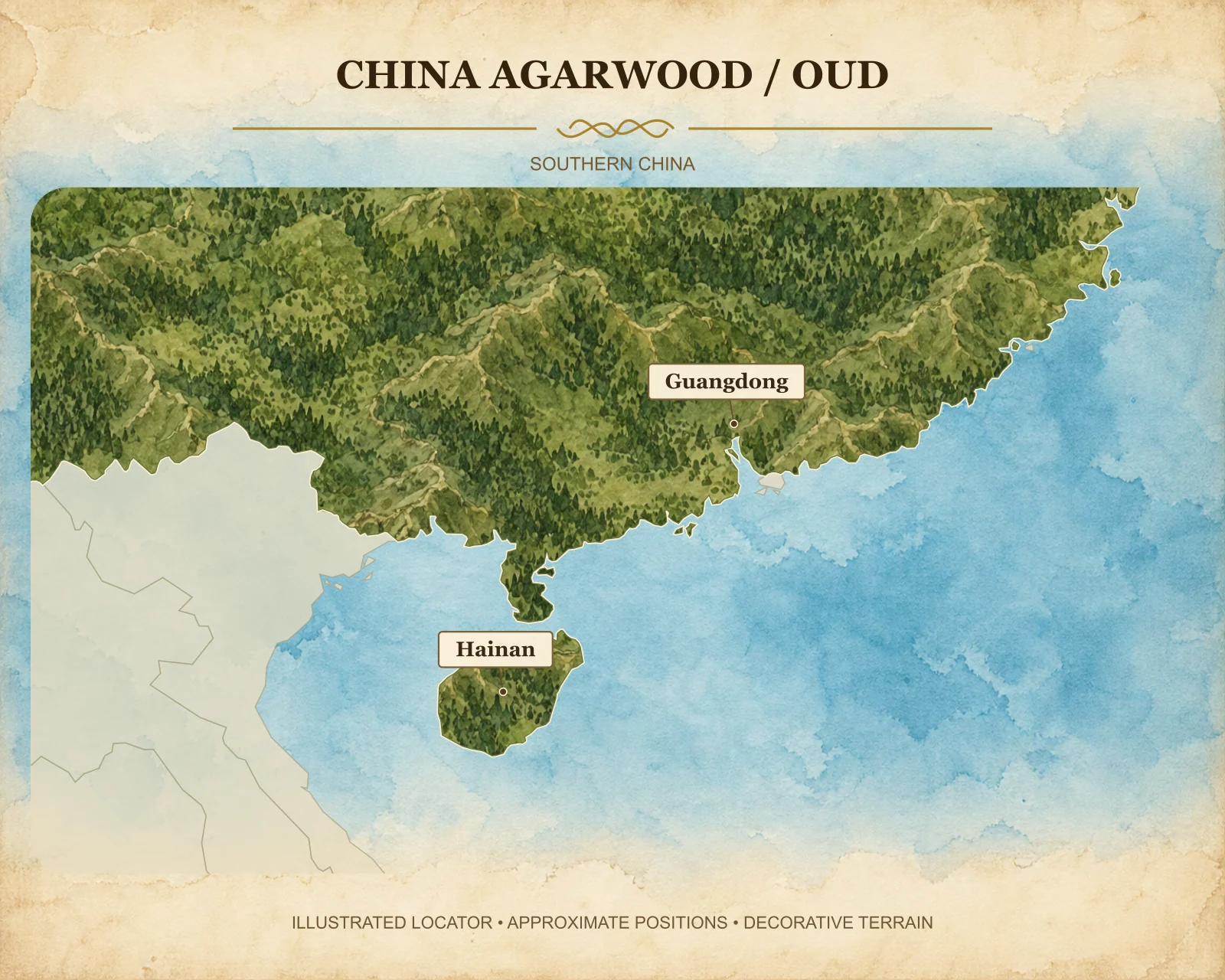
Chinese agarwood is commonly called chenxiang. Aquilaria sinensis is a significant source, and Hainan and Guangdong are important geographic references.
• Aroma: studies of Chinese samples document differing woody, sweet and spicy characters. Chenxiang is not one scent or proof of kinam quality.
• Identification: distinguish Hainan Island from mainland Guangdong; check species, lot and treatment, not just the name or colour.
• Suggested use: quiet incense sessions to explore the aroma, or gifting to a woody-fragrance enthusiast if the sample suits their taste.
78. Hainan Oud
• Hainan Island / Province.
• A southern island province.
• Check botanical identity.
• Guangdong Province.
• A mainland southern province.
• Check botanical identity.
Sri Lanka oud
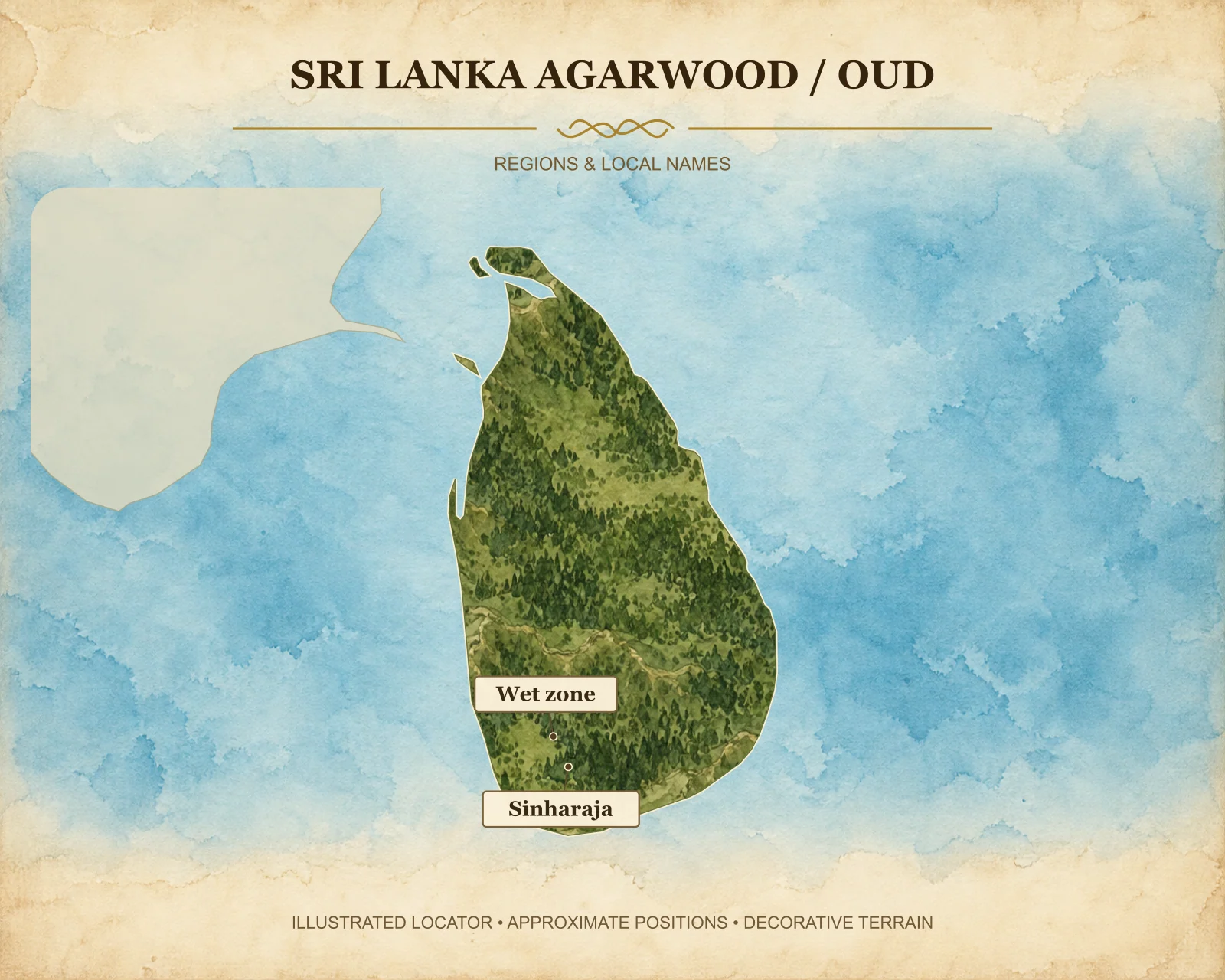
Ceylon is the historical name used in trade for Sri Lanka. The local tree name Walla Patta is associated with Gyrinops walla, which has been studied for its agarwood resin.
• Aroma: Ceylon or Walla Patta does not establish one fragrance profile. Assess actual samples of the wood and oil before purchasing.
• Identification: Walla Patta is a tree name associated with Gyrinops walla. Sinharaja does not certify lawful harvesting or grade.
• Suggested use: chips for incense and oil for fragrance as labelled. Try a small sample before choosing it for hospitality or a special gift.
80. Ceylon Oud / Sri Lankan Agarwood
• Sri Lanka’s wet zone.
• National/historical trade name.
• Confirm the tree species.
• Sinharaja forest area.
• A forest-area name, not a quality grade or evidence of legal harvesting.
• Confirm the tree species.
82. Walla Patta
• Local name of the agarwood producing tree; not a place.
• Local tree name associated with Gyrinops walla. It is deliberately not assigned a map pin.
• Confirm the tree species.
Philippines oud
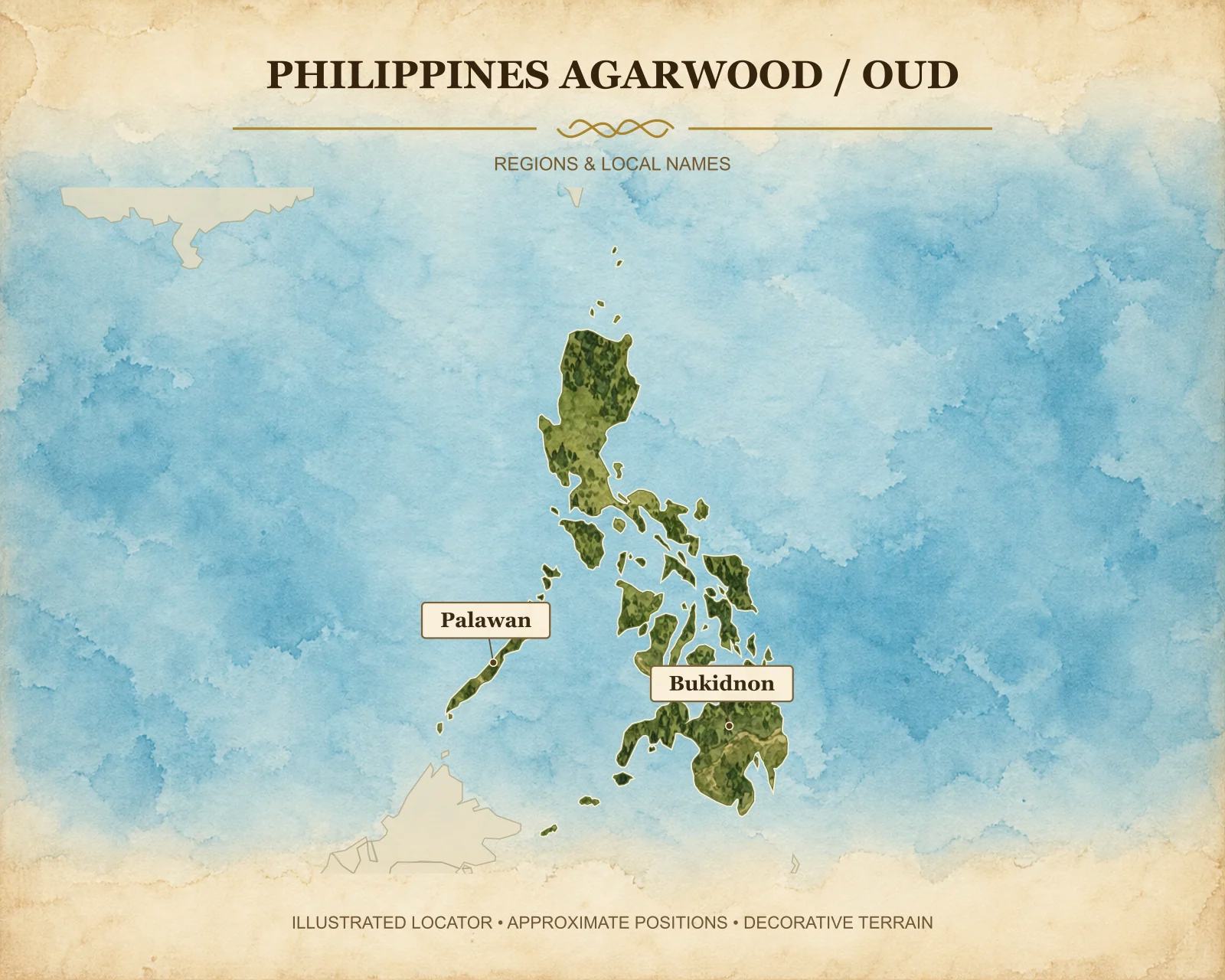
Philippine oud is a national origin label. DENR research documents native Aquilaria resources in Mindanao; Palawan and Bukidnon are geographic names in the supplied list, not certified origins for a retail product.
• Aroma: this guide has no verified sensory data distinguishing Palawan from Bukidnon. Assigning a fixed scent to either would be misleading.
• Identification: ask for tree identity, lot origin and treatment. Wood shape or a photograph cannot certify Philippine provenance.
• Suggested use: a gentle sample for daily incense or a tested product for guests; choose by aroma, budget and clear disclosure.
83. Palawan Agarwood
• Palawan island / province.
• An island/province name.
• Check supplier records.
• Bukidnon Province, Mindanao.
• A province on Mindanao, distinct from Palawan.
• Check supplier records.
Papua New Guinea oud
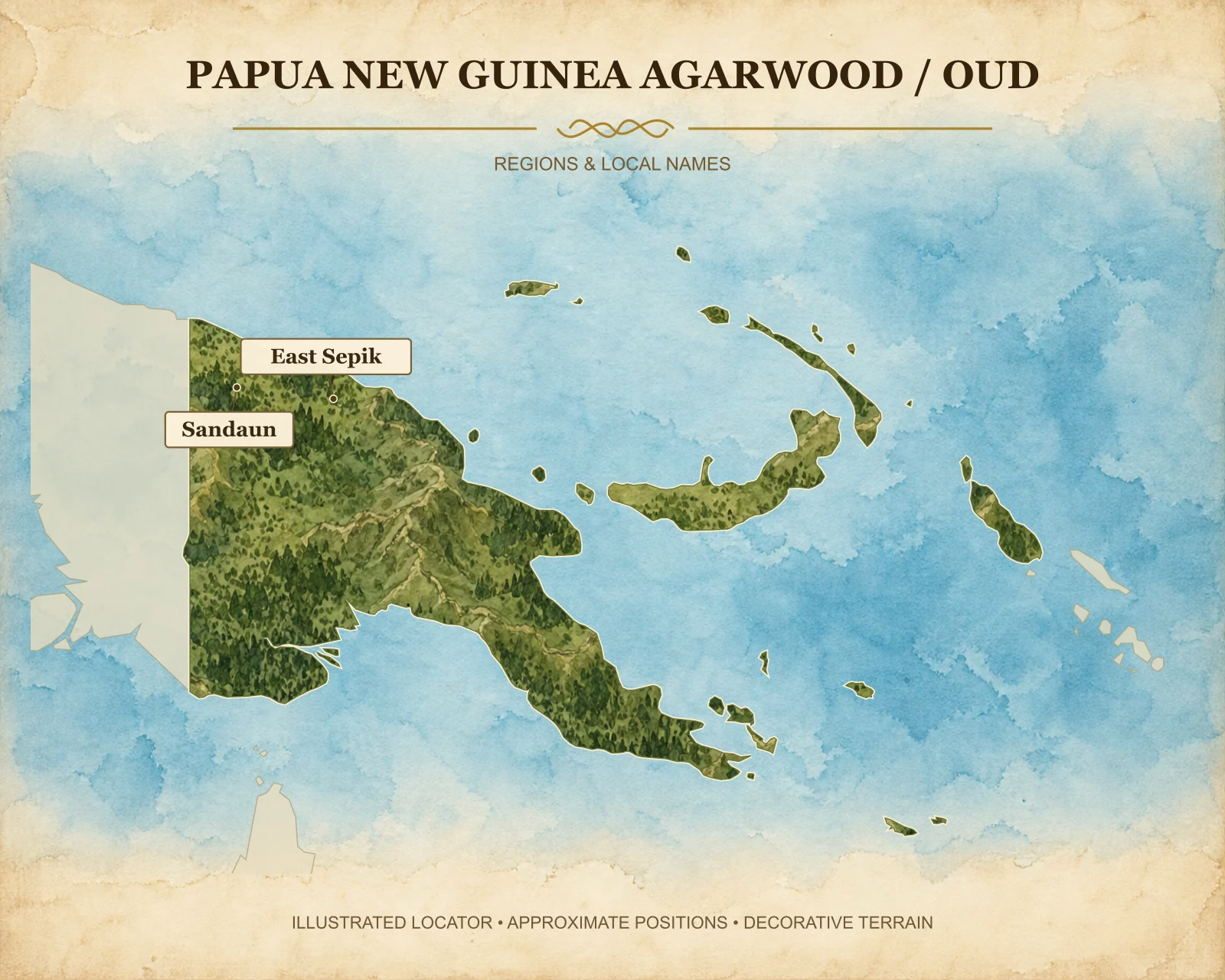
Papua New Guinea is a separate country from Indonesian Papua, although both occupy parts of the island of New Guinea. Eaglewood is a common name used for local agarwood.
• Aroma: eaglewood means agarwood, not a fragrance note. Chips and oils vary, so the Sepik name alone cannot establish a scent.
• Identification: confirm the country; Papua New Guinea is distinct from Indonesian Papua. Request batch and treatment information.
• Suggested use: home or majlis incense that suits your taste, or a gift with traceable origin. Test a sample before buying for an event.
• East Sepik Province.
• An eastern Sepik province label.
• Confirm country of origin.
86. Sandaun / West Sepik Agarwood
• Sandaun Province.
• Sandaun is also known as West Sepik.
• Confirm country of origin.
Names awaiting geographic confirmation
The following names lack confirmed geographic identification; no exact location, tree or scent is assigned. Their links open the general oud collection: Grihang · Kamidop / Kahidup · Bousong · Boukan · Boukang · Batmab · Kampung (incomplete name)
Photographed examples from our store

Assam Indian oud 561 — store product photograph

Indian Earthy Oud Oil 158 — store product photograph
Understanding production and treatment
Wild-source oud: From trees outside plantations; the label alone does not guarantee age, quality or lawful sourcing.
Cultivated oud: From planted trees, with spontaneous or induced resin formation. Cultivation does not make oud fake.
Induced agarwood: Resin forms inside the tree after wounding or induction. This differs from adding fragrance to harvested wood.
Enhanced or scented wood: Aromatic materials are added after harvest and should be disclosed. It is not automatically equivalent to cultivated oud.
Oud oil: Depends on raw material, preparation, distillation, ageing and any dilution. Ask whether it is pure oud oil or a fragrance blend.
How to choose oud
Compare a sample and ask about origin and treatment. Colour or sinking alone does not prove quality; super grades vary by supplier. Store away from heat and sunlight.
Shop oud oil · Shop enhanced oud
Sources and approach
Names were compiled from the reference list and separated from botanical facts. Sources do not authenticate every trade label or product. Maps use Natural Earth data and approximate locators; regional names do not assert current administrative boundaries.
CITES: agarwood · Assam: cultivation · Indonesia: Gyrinops · SAU: Bangladesh · AFCD: Chinese agarwood · Sri Lanka: resin study · DENR: Aquilaria · ACIAR: PNG forestry
Be the first to review!